Background · Draft
GTM: A Path Forward
Why go-to-market is broken in most hybrid PLG + SLG companies, what a new integrated model looks like, how to organize your team to actually deliver it, and a practical way to assess where you are today.
By Shane Murphy-Reuter · A working draft
Preface
Background & Context
Author's note: the examples I give below are real but in most cases I've removed the company name… for obvious reasons.
Preface
About Me: The Author
I've spent the last 10 years working in late stage companies as they set about trying to extend their growth beyond the organic growth achieved from hitting Product Market Fit in an early adopter market. I will admit the first time I did this at AdRoll I didn't have a clue what I was doing. In my last year I got the opportunity to run both sales and marketing which was my first taste of trying to create a cohesive GTM — however I just didn't have the experience to achieve it.
By the time I got to Intercom I was determined not to make the same mistakes, however joining as SVP Marketing and trying to define an end-to-end GTM strategy in partnership with a Head of Sales proved very difficult. We both had our, well intentioned, views on how the strategy should be run and despite our best efforts we ended up creating a bit of a two-headed monster. I skewed towards self-serve (having come from a consumer marketing background) and our head of sales skewed sales led. We managed to make it work and Intercom scaled from under $100m to over $300m but I believe we could have grown faster had GTM been more in sync.
This pattern repeated itself when I joined Webflow. A business with a very similar set up to Intercom. Founded with a PLG motion, then set up a sales machine once it felt the pull from upmarket companies. When I joined there was another awesome head of sales but again we ended up struggling to create a cohesive GTM as we both had different default positions on what our GTM approach should be. In fact, it got to the point where the board pondered if we should just split the company in two and have one focused on the downmarket with a PLG motion and one focused on the upmarket with an SLG motion. Webflow ultimately made the decision to shift the whole company focus upmarket so at least they chose a path. Whether it will be successful is to be seen but at least they chose one strategy and hired in a new CRO to lead a combined GTM machine.
Now at this point you might be thinking… Shane, maybe you're just a shit collaborator… maybe that's true… but then you look at the external data and heads of marketing and heads of sales are rarely successful in role.
The data
Exec Retention Rates & Implied Median Tenures by Title
GTM leaders have the shortest median tenures in tech, ranging between ~1 and ~1.5 years.
| Exec Title | n | Retention | Median Tenure |
|---|---|---|---|
| Chief Executive Officer | 5,602 | 81% | 3.29 years |
| VP of Legal | 107 | 80% | 3.11 years |
| President | 343 | 80% | 3.11 years |
| Chief Technology Officer | 2,089 | 77% | 2.65 years |
| Chief Operations Officer | 2,387 | 76% | 2.53 years |
| SVP of Operations | 103 | 75% | 2.41 years |
| Chief Information Security Officer | 234 | 74% | 2.3 years |
| VP of Operations | 550 | 73% | 2.19 years |
| VP of Finance | 688 | 72% | 2.1 years |
| Chief Information Officer | 160 | 72% | 2.1 years |
| SVP of Engineering | 199 | 72% | 2.1 years |
| Chief People Officer | 322 | 72% | 2.1 years |
| VP of HR | 871 | 71% | 2.02 years |
| Chief Scientific Officer | 142 | 70% | 1.94 years |
| SVP of Finance | 128 | 70% | 1.94 years |
| Chief Product Officer | 848 | 70% | 1.94 years |
| Chief Legal Officer | 111 | 70% | 1.94 years |
| SVP of HR | 141 | 70% | 1.94 years |
| Chief Financial Officer | 1,253 | 70% | 1.94 years |
| VP of Design | 155 | 68% | 1.83 years |
| VP of Engineering | 1,318 | 68% | 1.83 years |
| Chief Customer Officer | 829 | 66% | 1.67 years |
| VP of Business Development | 436 | 66% | 1.67 years |
| VP of Product | 1,366 | 64% | 1.55 years |
| SVP of Marketing | 204 | 63% | 1.5 years |
| Chief Medical Officer | 107 | 63% | 1.5 years |
| SVP of Product | 294 | 61% | 1.4 years |
| VP of Customer Success | 497 | 61% | 1.4 years |
| SVP of Sales | 318 | 60% | 1.36 years |
| VP of Sales | 1,314 | 60% | 1.36 years |
| VP of Growth | 207 | 59% | 1.31 years |
| VP of Marketing | 1,078 | 59% | 1.31 years |
| Chief Marketing Officer | 879 | 58% | 1.27 years |
| Chief Revenue Officer | 602 | 55% | 1.16 years |
Source: Pave. All data points come directly and in real-time from Pave customers' HRIS, Payroll, ATS, and Equity Management systems.
Add to this the fact that most founders are product people or technologists who don't know how to steer a GTM org and you are left with a potentially rudderless ship… or maybe a better way to say it is a ship with two rudders pointing in different directions. I strongly believed there must be another way.
I wrote out my thesis for it (covered in this doc) and joined Calendly to put it into action as President of GTM. So far, while there has been some pain in shifting to a new model, I've never felt more confident in how companies should set up their GTM.
Before I go any further I want to be really clear what my predominant experience is and therefore who should read this. The companies I've worked for and who can directly learn from this are:
- 1. Found PMF in a large early adopter market and saw hyper growth as an early stage company
- 2. Started with a self-serve or Product Led Growth (PLG) motion
- 3. Built out a Sales-led (SLG) motion as they began to get pull from larger companies who needed sales support
- 4. Typically Series B–D
That's my sweet spot. I'm sure other companies can learn from this too — maybe you're at an earlier stage and trying to get ahead of the pitfalls of a later stage, or at a later stage trying to undo them. Regardless I hope this is of value to whoever reads it.
Lastly, I also want to be honest and say that trying to move to this model and ensure every part of your GTM is excellent is extremely difficult. I've included where I believe my Calendly GTM was when I started and where it is now and you'll see that I have very few really strong spots. This is due to the nature of a fast moving, ever changing environment and the need to prioritize where you need to be excellent and where being ok is… well ok.
Preface
What we can learn from R&D Teams
GTM is not the first discipline to struggle with the best way to organize. R&D teams struggled with this for a long time before aligning on the widely adopted "triad" model.
The triad model outlines clearly how three roles work together:
- 1. The Product Manager — what to build: defines the product strategy all the way down to specific product requirements.
- 2. The Designer — designs how the product should look and operate.
- 3. The Engineer — builds the product to the spec and designs provided.
These three functions work very closely together, each one informing the other. Of course most R&D orgs also have some centralized functions like ops and research but those teams support and inform the triad. This was not always the way — ChatGPT informs me that the triad model only became truly adopted in the mid 2010s.
Preface
The evolution of GTM
So what about GTM? Why don't we have a similar model? Well, we used to — and then the world changed.
1. Phase 1: Enterprise Sales Led GTM — This worked
- · In the early days of tech when implementation was difficult and the tech costly to set up and maintain there was a more typical enterprise sales motion.
- · The head of sales was the effective head of GTM.
- · The CMO's job was to support the sales org by enabling sales with messaging and content and to drive pipeline.
- · This model continues to exist in Enterprise Sales-led motions.
- · This was the model at Zoominfo when I was there and while I didn't really enjoy the role this was a very effective GTM org.
2. Phase 2: The emergence of PLG — This also worked
- · As technology became more broadly accessible a self-serve PLG motion was established in companies attacking the SMB space. It took lessons from the B2C world and applied a B2B overlay.
- · This was very effective in serving companies like Atlassian who leaned into this as the primary motion in the early years.
- · In this world roles are also clearer. The CMO is the effective head of GTM given the channels to take the product to market are all scaled marketing channels.
3. Phase 3: PLG & SLG Hybrid — We are HERE today and it's fucked
- · In most PLG businesses, ultimately there becomes pull from upmarket companies who want to adopt your technology.
- · Oftentimes there has been bottoms-up adoption of the product within the company and then the leaders realize they need to do a proper procurement process to formalize the purchase.
- · Slack is one of the most brilliant examples of this. It exploded within companies as small teams adopted it bottoms-up leading to pull from the organization as a whole.
- · As a result, sales motions were spun up within previously PLG businesses.
- · The challenge: most companies hired a sales leader from a typically Enterprise sales company. This person comes in incentivized to generate revenue through their motion — that's what they're comp'd on.
- · Now you have a leader on the exec team with misaligned incentives to the rest of the company. They also come from a background that typically doesn't understand the PLG world and they come in with a playbook and implement it.
- · This leads to PLG and SLG motions existing in silos and causes a lot of friction, internally and for the customer.
- · It's unclear who owns GTM strategy. The head of sales owns it for Enterprise; the head of marketing is typically not empowered to own it for SMB — leading to diffusion of responsibility for that segment across the leadership.
- · The head of marketing role becomes impossible to succeed in. Pulled in a million directions, expected to be expert in both SMB and Enterprise GTM, and both an analytical growth leader and a creative Brand & PMM leader.
4. Phase 4: Integrated GTM — The future for hybrid companies
I'll spend more time on this through this doc, but summarized:
- i. You have a Head of GTM that owns GTM end-to-end including sales and marketing.
- ii. Their most important direct report is a Head of Strategy and Operations who owns the design, measurement and implementation of a hybrid GTM motion.
- iii. The other parts of GTM are then broken out into more discrete functions aligned around 3 core skillsets:
Creative Storyteller
Brand & PMM leader
Analytically Technical Builder
Growth leader
People & Process Driver
Sales & Support leader
There are many ways to organize to achieve this. I'm not saying you have to organize exactly this way, but you need to ensure that you have these areas covered and if you split them out the person those areas report into needs to be the one driving alignment.
Section 1
GTM Today: A broken model
Diffusion of responsibility: the death of GTM
I was sitting in my first board meeting at Company. I gave an update on what I was doing to drive the self-serve business then handed to our head of sales who gave an update on the sales business. One of the board members asked… how does your GTM work? What's your flywheel, how does your self-serve business connect to your sales business? We all looked at each other. Waiting for someone to answer. No one had asked that before. We didn't know the answers. We also didn't know who owned answering them.
A number of board meetings passed and we would answer the question in parts but it was still me presenting the self-serve business performance and our head of sales presenting the sales business — and the questions would invariably end up at the same place: how are these businesses connected and reliant on each other versus not. At one point the board meeting ended with the board wondering whether it was better to just split the company in two and have one company focused on the SMB market with a self-serve motion and one focused on the upmarket with a sales-led motion. It was abundantly clear to me, and others, that our lack of a single GTM leader was at risk of destroying our momentum. A classic case of diffusion of responsibility: when you don't have a single clear owner of something, no one owns it.
I started to see this issue crop up across many other areas too. Before I go too far into these I want to say that the team at all the companies I've worked at were all crazy talented, wonderful humans — they were just growing so fast in the early days that the GTM motion evolved organically rather than being deliberately planned end to end. I see these issues at tons of other companies too. With that said these are the other issues that cropped up:
Self-serve growth
In one of my first exec meetings at Company, we were looking at revenue data and could see softness in our self-serve business. We discussed potential causes and then moved on. I pulled us back. "Wait — who owns this problem?" Silence. I pointed to our VP Sales: "If there was an issue in our sales business I promise you VP Sales would be all over it." At the time self-serve made up 80% of our revenue and yet no one directly owned the business.
The company had grown up as self-serve only and so ownership had been diffused across all execs. In a larger, more mature business that gap in ownership was leading to a significant issue in how we managed the business. After that meeting we agreed I should own the self-serve business at Company. We moved the head of growth from product and combined her team with my growth marketing team to ensure singular ownership of self-serve growth. A step in the right direction.
It's not necessary for all self-serve to report into one exec. At Calendly we have a Product Growth leader with a Marketing Growth counterpart but they are both drivers of a cross-functional working group with myself and the CEO as exec sponsors. You don't need hard-line reporting — you need an organizing principle to avoid lack of alignment.
Sales revenue target setting
When we set revenue goals for sales there was a lack of ownership on how to set them and how to lock arms between sales and marketing. When I joined they had set the revenue plan on a classic sales-led model — bottoms-up based on number of reps and rep capacity. By the time I joined the sales team were missing goal and fingers were being pointed at marketing for not driving enough leads. That's when I uncovered that the model was set bottoms-up with no consideration for what that meant for the upper funnel.
Again, a lack of coordination and ownership across the sales business. The person who owned it was the sales leader but the growth was fully reliant on marketing lead gen. The sales team was responsible for closing the pipe created by marketing. They had built a sales model completely reliant on demand gen and given ownership of that to someone who didn't understand it or own it.
The company story
In most companies, PMM owns the product story and Brand owns the company narrative. In theory that sounds fine. In reality, they rarely connect. You end up with a product story that doesn't ladder up to anything meaningful and a brand narrative that feels detached from what you actually sell.
I remember sitting in a campaign planning review looking at the roadmap and asking to see how everything tied together over the next quarter. Someone walked me through the brand campaigns. Then someone else walked me through the product launches. I asked how they connected. Blank stares. "Oh, these are separate plans." I was genuinely flabbergasted. Two completely different narratives, two timelines, two sets of priorities — running in parallel with no single thread tying them together.
It gets worse in execution. You have two separate campaign plans — brand and product — without any unifying story. Customers don't get a clear, consistent narrative, campaigns don't build on each other, and instead of compounding momentum you just create noise. Another classic example of diffusion of responsibility — no one owns the story end to end, so no one really owns it at all.
Data & automation
Another place this breaks down is in data, systems and automation. When I joined Company, ownership was split between marketing ops and sales ops. On paper that sounds reasonable. In reality it was a mess. There was no single source of truth because each team had their own definitions, dashboards and priorities. The systems didn't properly talk to each other, so you'd get different answers to the same question depending on where you looked.
When it came to automation, no one really owned it end to end. Marketing ops automated parts of the funnel; sales ops automated parts of theirs; there was no cohesive view of how it all stitched together. I remember asking a simple question about funnel conversion and getting three different answers from three different systems. At that point you realize you don't just have a data problem — you have an ownership problem.
In an AI world this becomes a massive blocker. If your data isn't clean, connected and clearly owned, and your systems aren't integrated, you simply can't build or deploy meaningful automation. Instead of compounding leverage, you end up with more fragmentation.
The customer journey
Without a single owner of GTM there was no single owner of the customer journey. Sales were incentivized to maximize sales-led revenue and given they had a seat at the exec table they obviously pushed for things that would drive sales revenue even if it ultimately hurt the business. This wasn't deliberate. Often the upside is easily quantifiable and the downside less so — so it's easy to convince yourself something is the right thing to do if you have the incentive to do it.
All this is to say… the way GTM teams are traditionally set up is really quite messed up. I was convinced there was a better way. At Company, together, we made a lot of progress but never fully. When I joined Calendly I was committed to fixing this.
Section 2
A New Model for GTM
Before we dive in — when I talk about a "new model" I'm not claiming to have invented some revolutionary framework that no one has ever thought of. Most of the individual components I'm going to describe exist in some form in most companies. The point is about how they fit together, who owns them, and how the org structure needs to change to actually make that happen. That's where most companies fall down.
The model has three layers. Think of them as the answer to three sequential questions:
01
What is our strategy?
How do we position ourselves in the market, tell our story, and design our channel and monetisation approach?
02
How do we execute it?
How do we take that strategy to market through campaigns, brand and demand channels, PLG motion, sales motion, and partner motion?
03
What are the foundations?
The creative, data, planning, and people infrastructure that either enables or constrains everything above it.
Miss any one of these layers and the thing breaks. Brilliant strategy without execution is theatre. Great execution without strategy is fast and directionless. Solid strategy and execution on rotten foundations quietly rots.
I've seen companies with brilliant strategy but little execution capability. I've seen companies that are exceptional at execution but with no coherent strategy underneath it — they're fast but directionless. And I've seen companies where strategy and execution are both solid but the foundations are rotten… data that doesn't connect, teams that don't collaborate, planning that resets every quarter. All three layers have to work.
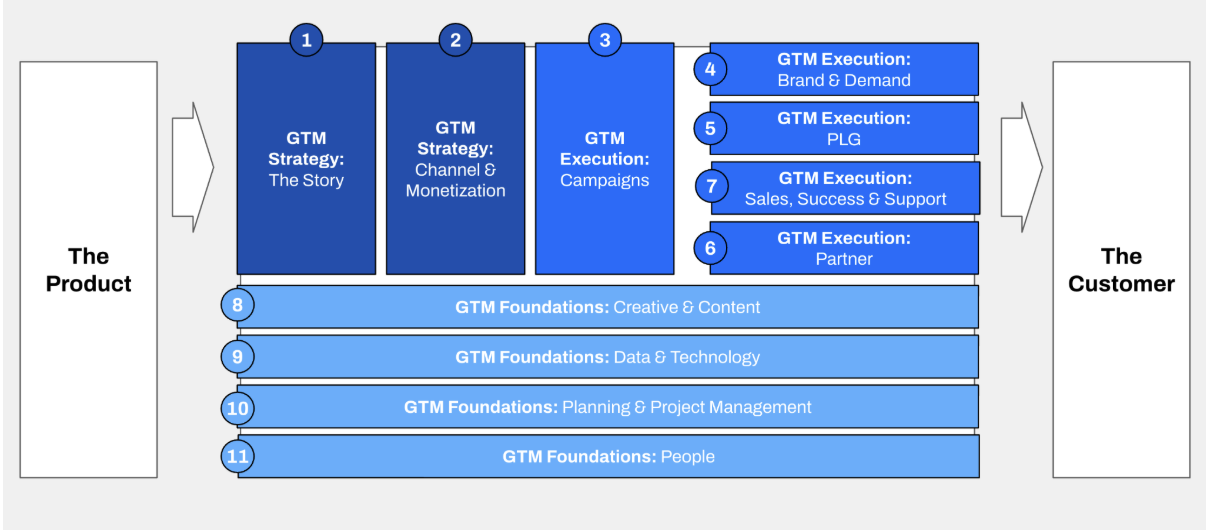
Layer 1: GTM Strategy
This is where it all starts. Before you run a single campaign or hire a single AE, you need to get two things right.
1. The Story. Why do you exist in the world? Who do you serve, what problem do you solve for them, and why should they choose you over the alternatives? This sounds obvious. It isn't. Most companies have some version of this written down somewhere and almost none of them have it working across the organisation. Marketing tells one version of the story. Sales tells another. The website says something different from the sales deck. The product doesn't quite match either.
I've seen this in every company I've worked at and it ultimately means the company doesn't scale. In the early days you're typically selling to a passionate early adopter market who go seeking you out. They take pride in trying the cool new product but as you scale you now need to resonate with a market who are more stuck in their ways. Your story needs to unstuck them. This is the classic "crossing the chasm" — but what I've learned is that you're constantly crossing chasms and to do that your story needs to be crystal clear. The best companies have a clear and connected story from their mission statement all the way to product features. They have it verticalized. They have versions for different buyer personas. This is deep and important work.
2. Channel and Monetisation Strategy. Once you know who you're selling to and why they buy, you have to decide how you're going to sell to them and how you're going to charge them. These two things are deeply intertwined and most companies treat them as separate decisions made by separate functions. They're not. You can read more about this in Brian Balfour's excellent four fits framework. If you're selling a highly technical product that needs a lot of technical implementation you'll need a sales-led motion and will need to charge high prices to cover that cost. However if you're selling a simple app you won't be able to charge much for it and therefore won't be able to afford a sales motion. They are intertwined, and most businesses end up with multiple approaches as they attack multiple markets. The key is ensuring they work together.
Have you deliberately defined when sales outreach adds value to the customer and is delivered at a reasonable CAC? Have you aligned on the difference between a sales assist versus a true sales motion? Do you understand who is part of the decision making process and if partners are involved? At Webflow the majority of our customers came to us through the agency that was designing their website. We got this wrong at Calendly before I joined. Calendly is a very simple product to use and adopt. It also struggles to demand a high per-seat price but yet during the COVID era of abundance a large sales machine was built to take the business upmarket. This ultimately failed. While we still have a sales motion it is now far more targeted on the right market segments and we have built a lower-CAC "sales assist" motion that covers the majority of the market needs, reserving our true enterprise motion just for the truly large Enterprise deals that come inbound (more on that later).
Layer 2: GTM Execution
This is where strategy becomes reality. And it breaks down into five distinct areas — each of which needs real ownership and real expertise.
3. Campaigns. I mean this in the broadest sense. Not just "what ads are we running this quarter" but the full campaign architecture — from flagship brand moments down to always-on product launches and feature activations. The companies that do this well have a campaign roadmap that's as rigorously planned as the product roadmap. They know what story they're telling, at what investment level, through which channels, and what success looks like. They don't react to product launches… they help shape them into bigger narratives. Marketing is an equal partner in deciding when things go to market, not a downstream recipient of product decisions.
4. Brand and Demand. When I speak of Brand here I mean the investments companies make to drive brand awareness. I've included it with demand gen because far too often people use the fact it's a "brand" investment to dodge the need for it to be measured to outcomes and as a growth driver of the business. The lines between a brand investment versus a demand gen investment is actually much more of a spectrum. For example if you buy a Superbowl ad you would expect it to drive demand not just be a brand builder. The best companies have a clear channel plan across channels and measure them appropriately in how they directly and indirectly drive company objectives. Often ownership of these channels sits on different teams as the skillsets to own channels like social are more creative versus paid search which is far more of a data-driven discipline. That said there should be one person ensuring that these channels are driving growth and are measured together.
5. Product-Led Growth. PLG is not a product feature. It's a go-to-market motion. It requires a defined activation metric, an instrumented onboarding experience, a conversion funnel with a real owner, lifecycle automation that actually personalises based on behaviour, and a bridge between what self-serve users are doing in the product and what the sales team should be prioritising. Most companies that call themselves PLG have a free tier, basic onboarding and experimentation in the funnel. The bar for what "good" looks like here is much higher than most people think.
6. Sales, Success & Support. Even in the most product-led business, you need humans at certain points in the customer journey. The question is where and how. The best companies have designed this deliberately. How humans support customers should be designed in a unified way from the lowest level free tier customer all the way up to true Enterprise customers. In most companies Sales and Support sit on separate teams leading to a bifurcation in the customer experience. This is sub-optimal and leads to poor outcomes for the customer. This should be designed and viewed as one system supporting the customer through buying, onboarding and using the product.
7. Partner. This is the most commonly under-invested area in GTM and the one that tends to get bolted on late when organic growth starts to plateau. A deliberate integration strategy, an active presence in the app marketplaces where your customers already live, and — for the right businesses — a structured channel programme can all become meaningful growth levers. But only if they're treated as strategic, not as a favour you do for ecosystem partners who ask nicely.
Layer 3: GTM Foundations
These are the things that don't directly generate revenue but that determine whether everything above them can work. Think of them like the infrastructure of a city — you don't notice them when they're working and you can't function when they're not.
8. Creative and Content. Can your team consistently produce high-quality, on-brand creative across every channel? Do you have a content strategy that actually serves the buyer journey, or a blog that exists to prove you're publishing something? The quality of your creative output is a direct reflection of how seriously you take your brand and your message.
9. Data and Technology. I talked about this in Section 1. When data ownership is split, you don't have data, you have disagreements. A single source of truth, a properly integrated tech stack, and now more than ever a clear plan for how AI can be leveraged across the department to improve decision making and automation.
10. Planning and Project Management. GTM without rigorous planning is just activity. The companies that consistently execute well have a planning cadence: annual, quarterly, monthly, weekly, daily… that allows for speed of iteration but with a clear north star that ensures it's not rudderless. OKRs that actually cascade. Forecast accuracy that's tracked and improved over time.
11. People. There is a lot I could speak to here… but the single MOST important thing this comes down to is: HIRING. If I could give younger me advice it would be — spend a disproportionate amount of your time figuring out how to hire well — and then I'd say — put a crazy high bar on core intelligence and a fire in the belly. That said, assuming you've solved for that, it's also important you solve for what happens when they join. I mean org design: who reports to whom, what's the DACI across the commercial org. I mean talent development: are you investing in the people you have or just backfilling the people you've lost. And I mean cross-functional culture: do your GTM teams actually plan together, or do they present to each other at a monthly meeting and then go back to doing whatever they were going to do anyway.
Section 3
Organizational Structure
As I've articulated earlier, the main issue with GTM teams is a lack of alignment and diffusion of responsibility. This is primarily driven by the fact GTM is split between a CMO and CRO typically reporting into a product-focused founder who can't or doesn't want to play the role of driving an aligned GTM strategy.
The model I now believe in looks like this…
The model in theory
President, GTM
How do I take products to market and establish sustainable growth for the company.
GTM Ops
Ensure GTM has a clear strategy, objectives, and uses data and automation to be highly efficient.
Brand & PMM
Position the company, build the brand, and generate excitement for new products.
Growth (PLG & SLG)
Generate and squeeze value out of the funnel to drive incremental revenue across the company.
Sales, Success & Support
Create an incredible experience for our customers when they need help buying, adopting and using the product — to drive revenue and retention.
A single Head of GTM who owns the whole thing — sales and marketing, PLG and SLG, brand and revenue. This person is accountable for the whole system, not just their slice of it. At Calendly this is what I was brought in to do as President of GTM.
A Head of GTM Strategy and Operations who is the Head of GTM's most important direct report. This role designs the GTM system, owns the measurement of it, and ensures it's actually implemented in the way it was designed.
Three functional leaders who own the execution areas, each built around a distinct and genuinely different skill set:
- The Creative Storyteller — Brand and PMM. This person lives in language, narrative, and customer insight. They own the story and its consistent expression in market.
- The Analytically Technical Builder — Growth. This person lives in data, experimentation, and product behaviour. They own the PLG motion and the quantitative engine underneath it. They also own the creation of demand into the SLG funnel.
- The People and Process Driver — Sales, Customer Success & Support. This person historically has been a sales leader who is good at rallying the troops to hit quota. I believe it's important that sales, success and support sit on one team to ensure a smooth service model across the tiers of customers. The lines between where sales starts and support ends should be gradual not abrupt. In this model this person spikes in operationally managing a team — excellent at analyzing funnels, building processes that reduce friction. Rallying the troops is important but not what this person needs to spike on; that's better handled by direct sales and support managers.
These three don't just report into the Head of GTM. They actively collaborate. The Storyteller's positioning informs the Builder's conversion experiments. The Builder's product usage data informs the Driver's sales prioritisation. The Driver's win/loss analysis feeds back into the Storyteller's messaging.
This model in practice
Getting to this model is hard. The reality is that often you don't have the right people to neatly fit into each of these roles, or you have parts of this that are a much higher priority than others. It is absolutely fine that you don't actually organize your GTM in this exact way — but I would strongly advocate that you ensure you have working groups formed around the ones you break out to ensure alignment.
Some common examples and how to avoid the issues I've highlighted:
1. Not hiring a single owner of GTM
- · This is a trickier one but is possible.
- · The key is that the CEO needs to have a clear view of the GTM strategy and actively work to drive alignment between Head of Marketing and Head of Sales.
- · The CFO also needs to be heavily involved in ensuring that the GTM goals across PLG and SLG are grounded in an aligned financial plan and upfront the executive team agree on the relative focus on each. The CFO needs to support the driving of an aligned view of what's truly driving revenue and therefore what the priorities for GTM should be.
2. Growth split between product and GTM
- · When I joined Calendly, growth overall reported into me.
- · However when the CEO stepped into personally own the product org we decided to split it back out to have a growth product team and a separate growth marketing team.
- · The key though is that the two leaders co-drive a formal cross-functional growth initiative with me and Tope (Calendly CEO) as the exec sponsors of the group. This ensures alignment of plans while also allowing for organizational alignment within teams.
3. Breaking out based on company priority and leader strengths
- · Depending on your business it's likely certain parts of your GTM are more important than others.
- · For those areas you may want your head of GTM to be closer to the day-to-day and therefore you may not want to hire a leader over those areas and have them report direct to the head of GTM.
- · For example at Webflow our partner program was absolutely critical to our growth and so I had our Head of Partner marketing report directly to me.
My overall point here is that, while I do believe that in a perfect world you organize around the roles I've outlined above, of course it is likely that you may not want to take such a big swing and change your org structure and that's ok. Things are dynamic but keeping these principles in mind as you build is the critical piece.
Section 4
Assessing your GTM
So far I've been pretty high level in outlining the new GTM model. I thought I'd put this more into practical terms by building a GTM assessment you can take.
I've built a detailed assessment framework that maps directly to the 11 components of the model in Section 2 — covering every layer from strategy through execution to foundations. For each component, there's a clear description of what best-in-class looks like, what a critical gap looks like, and a set of intake questions designed to cut through the noise and get to an honest answer fast.
The scoring is simple. Each component is rated on a 1–5 scale, and the rubrics give you concrete anchors at 1, 3, and 5 so the scoring isn't just vibes. When you add it up, your overall score tells you roughly where you are: foundation stage, building stage, scaling stage, or optimising stage. Each stage has a different set of priorities, and the framework helps you see them clearly.
A few things I'd encourage you to keep in mind when you use it.
This is a diagnostic, not a report card
The goal isn't to get a high score — it's to get an accurate one. The companies that get the most value from this are the ones that resist the temptation to rate themselves generously. A 3 that's really a 2 just means you fix the wrong things.
Adjust for your stage
This assessment is designed to scale to companies with an advanced GTM motion. If you are at an earlier stage you are very unlikely to be scoring high on any of these areas — and you shouldn't. See it more as a way to understand what the future could look like. At the earlier stage it's about being great at a smaller number of things resonating with the early market. At Intercom they nailed content marketing. At Zoominfo they nailed outbound sales. At Webflow they nailed community-driven growth.
Prioritise ruthlessly
You will not score 5 across all 11 components. No one does. Trying to improve everything at once is a good way to improve nothing. Once you have your scores, the question to ask is: which 2 or 3 gaps are most directly limiting our growth right now? Start there.
Give it a go
Take the GTM Self Assessment
The framework in practice — 11 components, honest scoring, and a clear picture of where to focus next.
Start the assessment →